When I asked, “Why?” I didn’t know they would forget
how they feared the holly tree would die,
where they had buried their pet.
The fear faded as the years went by.
How they feared the holly tree would die,
its roots stabbing deep into the rabbit’s skull,
the fear faded as the years went by.
They gathered holly berries by the bucket full,
its roots stabbing deep into the rabbit’s skull,
and scattered them on our trampoline.
They gathered holly berries by the bucket full,
the dirt scoured the rabbit’s bones clean,
and scattered them on our trampoline.
The reason? They avoided the holly tree,
the dirt scoured the rabbit’s bones clean.
“It’s Red Berry Day!” the children said to me.
This is part two of a poem/story sequence that I've been putting together for Flocoimo. Read more about Floyd County Imagination Month and see what some wonderful writers and artists are doing here: Ad Hominem
I’ve always thought of revelation as a divine manifestation of truth which comes in some dramatic form, a combustible bush, a tub-thumping, thunder rumbling voice from above, a moment extremely dramatic in nature which elevates its place in time beyond the present moment. A- GONG- of eternity if you will, a wind chime echo into forever, not just the pebble dropped to ripple in the pond but the pond in the ripple. All-encompassing. Rare. Special.
But maybe not.
Maybe revelations are more like leafs falling off trees, so ordinary and plentiful that unless you look closely and pay attention you don’t notice the patterns of sun and shade, the prism of light caught in the morning dew clinging to the last stubborn maple leaf-clinging to the tree, or the way the wind turns a pile of them into a tornado of color. You laughed at this when you were younger, do you remember?
Do you still laugh? Do you see each leaf, or just a pile of waste?
Hope is a frightening thing. When we kill wonder we don’t have to worry about hope.
Several years ago when my family was still new and small we went camping in Kentucky. It was early fall, the fields were freshly harvested and plowed. The earth smelled clean in a way that it can only smell when the air is so cold the inside of your nose twinges a bit when you breathe it in.
Our friends told us they often went arrowhead hunting when the fields were freshly plowed and this seemed like a splendid idea to me. Not to my husband. While I spent, oh at least a half a day walking the fields, keeping my eyeballs to the dirt, he preferred to stay in camp. I was annoyed at first that he didn’t care to join me on my quest but I got into my imagination and thought of who might have left arrowheads there, what they were doing, what happened to them. I began to say silent prayers, humming what I imagined was a Native American way of humming, hey ay ay ay, ho ay ay ay, softly to myself as I bent to pick over yet another clump of-looks-more- like- a- rock-dirt.
I lost track of time, I felt the sun begin to heat my face and arms and I wrinkled my nose up at it. Ouch, yup. I was getting fried. I was determined that I would absolutely not leave that field until I found an arrowhead. There was one there, I could feel it. I got into some kind of zone. Time didn’t mean anything. I ignored the rumble in my stomach. Forgot all about the people I was camping with and imagined the field in which I stood as it had looked a few hundred years ago.
“If I were an arrowhead, where would I be?” I found some rocks that were more granite and obsidian than dirt-clods and every time I found one my heart would pound and I would think, this is it. Each rock was THE ONE. This is it. No, toss. THIS is it. No. Toss. This one. No, this one. I lost myself completely in the process.
I finally found one. It was a beauty, too large to be only an arrow, it looked more like a spear tip. It was a deep gray and a contradiction of itself because although it was very sharp with hard edges it was butter smooth. It felt like magic. I felt like magic because I found it.
Fast forward twelve years. Our family is much larger. Five kids. We’ve hopped around a couple states and settled in Virginia. I didn’t have much time for things like hunting arrowheads, or showers for that matter. My husband and I were coaching a soccer team. It was a new soccer field and the grass was sparse but the rocks were plentiful. We were gathering as many rocks off the field as we could to make the area more safe for running when he found one. Just like that. He wasn’t even looking. He brought me over this beautiful white quartz triangular shaped rock.
“Hey! Is this an arrowhead?”
I took it my hands. A moment of intense jealousy reared up from somewhere deep. It was absolutely gorgeous. The edges were very thin, slightly chipped. It wasn’t as smooth as mine had been and much smaller. I doubt I would have recognized it for what it was if he hadn’t of placed it right in my hands. I recalled the effort it took for me to find “my” arrowhead. Why did he get to find one just like that, no hard work, no hours put in combing the ground, just bending over picking up rocks and there it is? That’s so not fair!
“Yup.” I said dryly, handing it back to him.
“Cool!”He said, “You keep it. I know you like that kind of stuff.”
I held it in my hands feeling slightly ashamed. Didn’t he understand what he’d just done? Didn’t he know how difficult finding one of those could be? How unique? How special?
He went off, gathering more rocks and tossing them off the field and I put the arrowhead in my pocket and stared after him, bemused.
I've thought about these two moments a lot over the years and I used to think that maybe he and I were just on different paths that led to the same place. I didn’t understand his way and he just didn’t understand mine. Maybe finding that arrowhead wasn’t so special or momentous. I worked, I looked I found it. He wasn’t looking and he found one and didn’t think much about it.
Lately these moments have come to my memory again and again but for some reason it’s finally (after so many years!) come to me, more of a –ping- than a –GONG-, and it’s a lesson I’ve learned before and seem to have to keep re-learning, maybe that’s what a revelation is, more or less, a full understanding of something we’ve not understood before.
What occurred to me was that my husband was just doing what he normally does, no one asked him to clear rocks from the field. He saw that there was a possibility that a child could get hurt so without thought to what was in it for him, or what he could get out of the situation, he just started picking up rocks and making the place safer. He wasn’t asking to be blessed, he wasn’t asking for anything. He was just paying attention and doing what needed to be done. While in my case I was most certainly expecting a blessing, looking for something, certain I’d find it. I’m not sure one way is better than the other because I know that when I found the arrowhead I was transported, in awe, it was a profound almost mystical moment for me. I held the arrowhead in my hands and felt the history, imagined the ghosts of the past whispering in my ear, approving my find. For him, it was an arrowhead, a rock on the field, a pretty trinket his wife might like.
His only joy in the find was in giving it to me.
So perhaps recognizing a blessing is like recognizing a revelation, it doesn’t matter if we look or not, it doesn’t matter if we feel it or understand it deeply to the core of our being…and it is silly to worry too much about it, it just is.
Thank you Guest Blogger Glennon from Momastery for allowing me to feature this:
Along with every other concerned mama, I’ve been watching America’s response to the bullying related suicides closely. People seem to be quite shocked by the cruelty that’s happening in America’s schools. I’m confused by their shock. I’m also concerned about what’s not being addressed in their proposed solutions.
The acceptable response seems to be that we need to better educate students and teachers about what bullying is and how to react appropriately to it. This plan is positive, certainly. But on its own, it seems a little like bailing frantically without looking for the hole in the boat through which the water is leaking.
Each time one of these stories is reported, the tag line is: “kids can be so cruel.” This is something we tend to say. Kids these days, they can be so cruel. But I think this is just a phrase we toss around to excuse ourselves from facing the truth. Because I don’t think kids are any crueler than adults. I just think kids aren’t quite as adept yet at disguising their cruelty.
Yesterday I heard a radio report that students who are most likely to be bullied are gay kids, overweight kids, and Muslim kids.
Hmmmmm.
I would venture to guess that at this point in American history, gay adults, overweight adults, and Muslim adults feel the most bullied as well.
Children are not cruel. Children are mirrors. They want to be “grown-up.” So they act how grown-ups act when we think they’re not looking. They do not act how we tell them to act at school assemblies. They act how we really act. They believe what we believe. They say what we say. And we have taught them that gay people are not okay. That overweight people are not okay. That Muslim people are not okay. That they are not equal. That they are to be feared. And people hurt the things they fear. We know that. What they are doing in the schools, what we are doing in the media - it’s all the same. The only difference is that children bully in the hallways and the cafeterias while we bully from behind pulpits and legislative benches and one liners on sit-coms.
And people are sensitive. People are heart-breakingly sensitive. If enough people tell someone over and over that he is not okay, he will believe it. And one way or another, he will die.
So how is any of this surprising? It’s quite predictable, actually. It’s trickle-down cruelty.
I don’t know much. But I know that each time I see something heartbreaking on the news, each time I encounter a problem outside, the answer to the problem is inside. The problem is ALWAYS me and the solution is ALWAYS me. If I want my world to be less vicious, then I must become more gentle. If I want my children to embrace other children for who they are, to treat other children with the dignity and respect every child of God deserves, then I had better treat other adults the same way. And I better make sure that my children know beyond a shadow of a doubt that in God’s and their father’s and my eyes, they are okay. They are fine. They are loved as they are. Without a single unless. Because the kids who bully are those who are afraid that a secret part of themselves is not okay.
****
Dear Chase,
Whoever you are, whoever you become. You are loved. You are a miracle. You are our dream come true.
Chase, here is what would happen in our home if one day you tell your father and I that you are gay.
Our eyes would open wide.
And we would grab you and hold you tighter than you would be able to bear. And while we were holding you we would say a silent prayer that as little time as possible passed between the moment you knew you were gay and the moment you told us. And that you were never once afraid to tell us. And we would love you and ask you one million questions and then we would love you some more and finally, I would likely rush out to buy some rainbow t-shirts, honey, because you know mama likes to have an appropriate outfit for every occasion.
And I don’t mean, Chase, that we would be tolerant of you and your sexuality. If our goal is to be tolerant of people who are different than we are, Chase, than we really are aiming quite low. Traffic jams are to be tolerated. People are to be celebrated. People, every person, Is Divine. And so there would be celebrating. Celebrating that you would be one step closer to matching your outsides with your insides, to being who you are. And there would be a teeny part of my heart that would leap at the realization that I would forever be the most important woman in your life. And then we would tell everyone. We would not concern ourselves too much with their reactions. There will always be party poopers, baby.
We just wanted you to know this, honey. We’ve worried that since we are Christians, and since we love The Bible so much, that there might come a day when you feel unclear about our feelings about this. Because there are a few parts in The Bible that discuss homosexuality as a sin. So let us be clear about how we feel, because we have spent years of research and prayer and discussion deciding.
Chase, we don’t believe that homosexuality is a sin. Your parents are Christians who carefully choose what we believe and follow in the Bible. Some will tell you that this approach to Christianity is scandalous and blasphemous. But the thing is, honey, that the only thing that’s scandalous about this approach is admitting it out loud. The truth is that every Christian is a Christian who picks and chooses what to follow in the Bible.
Several years ago I was in a Bible study at church, and there was some talk about homosexuality being sinful, and I spoke up. I quoted Mother Teresa and said “When we judge people we have no time to love them.” And I was immediately reprimanded for my blasphemy by a woman who reminded me of 1 Corinthians 6: 9-10. But I was very confused because this woman was speaking. In church. And she was also wearing a necklace. And I could see her hair, baby. She had no head covering. All of which are things that are sooooo totally against the Bible Rules. * And so I just assumed that she had decided not to follow the parts of the Bible that limited her particular freedoms, but to go ahead and hold fast to the parts that limited other people’s freedoms. I didn’t point this out at the time baby, because she wasn’t a bad person. People are doing the best they can, mostly. It’s best not to embarrass people.
What I’m trying to say is that each Christian uses different criteria to decide what parts of the Bible to prioritize and demonstrate in their lives. Our criteria is that if it doesn’t bring us closer to seeing humanity as one, as connected, if it turns our judgment outward instead of inward, if it doesn’t help us become better lovers of God and others, if it distracts us from remembering what we are really supposed to be doing down here, which is finding God in every human being, serving each other before ourselves, feeding hungry people, comforting the sick and sad, giving up everything we have for others, laying down our lives for our friends . . . then we just assume we don’t understand it yet, we put it on a shelf, and we move on. Because all I need to know is that I am reborn. And here’s what I believe it means to be reborn:
The first time you’re born, you identify the people in the room as your family. The second time you’re born, you identify the whole world as your family. Christianity is not about joining a particular club, it’s about waking up to the fact that we are all in the same club. Every last one of us. So avoid discussions about who’s in and who’s out at all costs. Everybody’s in, baby. That’s what makes it beautiful. And hard. If working out your faith is not beautiful and hard, find a new one to work out. And if spiritual teachers are encouraging you to fear anyone, watch them closely, honey. Raise your eyebrow and then your hand. Because the phrase repeated most often in that Bible they are quoting is Do Not Be Afraid. So when they tell you that gay people are a threat to marriage, honey, think hard.
I can only speak from my personal experience, but I’ve been married for eight years and barely any gay people have tried to break up my marriage. I say barely any because that Nate Berkus is a little shady. I am defenseless against his cuteness and eye for accessories and so he is always convincing me to buy beautiful trinkets with our grocery money. This drives your sweet father a bit nuts. So you might want to keep your eye on Berkus. But with the exception of him, I’m fairly certain that the only threats to my marriage are my pride and anger and plain old human wanderlust. Do not be afraid of people who seem different than you, baby. Different always turns out to be an illusion. Look hard.
Chase, God gave you the Bible, and He also gave you your heart and your mind and I believe He’d like you to use all three. It’s a good system of checks and balances He designed. Prioritizing can still be hard, though. Jesus predicted that. So he gave us this story. A man approached Jesus and said that he was very confused by all of God’s laws and directions and asked Jesus to break it down for him. He said, “What are the most important laws?” And Jesus said, “Love God with all your heart, mind and soul, and love others as yourself.” ** When in doubt, Chase, measure all your decisions and beliefs against that. Make damn sure that you are offering others the same rights, courtesies, and respect that you expect for yourself. If you do that, you can’t go wrong.
Chase, you are okay. You are a child of God. As is everyone else. There is nothing that you can become or do that will make God love you any more or any less. Nothing that you already are or will become is a surprise to God. Tomorrow has already been approved.
And so baby, your father and I have only one specific expectation of you. And that is that you celebrate others the way we celebrate you. That you remember, every day, every minute, that there is no one on God’s Green Earth who deserves more or less respect than you do, My Love.
“He has shown you what is good. And what does the Lord require of you? To act justly and to love mercy and to walk humbly with your God.” ***
Love, Mama
PS. We thought we should mention, honey, that if you’re straight, that’s okay too. I mean, it’d be a little anti-climactic now, honestly. But your father and I will deal.
PPS. All of the above holds true if you are overweight or Muslim too. No problem on either count.
PPPS. As daddy read this essay, I watched his gorgeous face intensify. He teared up a little. Then he slammed the letter down on the kitchen table and said emphatically and without a touch of irony, “DAMN STRAIGHT.”
Which, when you think about it honey, is really the funniest possible thing daddy could have said.
The moon’s romance was wasted
on the dust of the first moonwalker’s feet.
Science is its own religion. What the hell
is anti-matter anyway? Likely the origins
of all things polyester.
What happens when we are brave
or stupid enough to measure lightning
with a ruler? Oh Vitruvius.
De architectura. Consider
the ruined columns of the temple.
It’s not easy to be as incorruptible
as stone.
Galileo got it wrong.
Galileo, who in the Dialog of the Ebb
and Flow of the Sea,
called out the moon for folly,
became Galileo, the man in chains.
No one would hear. No one would see.
His terrestrial telescope, broken.
Does revelation have a surface
or a center? Look elsewhere.
Look through.
Tonight, the sky is missing a moon.
Orion inclines over the earth,
his belt buckle rides the horizon.
wake up heavy with the
idea of suicide on some bright
blue july morning and
then what?
you need to look in all
directions here
you need to consider hope
vs
the possibility of hope
your children as a
form of salvation
salvation as a concept that
might
actually have some meaning
ash wilderness
the edges of cities
where the bodies are buried
the sides of hills and
the scrubland on either side of
the highways
and it matters that i love you
but not enough
it makes its own grey logic
that the killers need
to be killed
ask any parent
how old their child
would've been and then
look at their hands when
they answer
look at your own
use them to dig out
whatever space you can find
between anger and despair
a forest
growing up quietly,
invisibly,
or this is what you thought
growing up without limitations
and then dying
write your name
backwards
in the book of crows
hang a cross in
front of every mirror
religion, yes, and then
superstition
and then genocide
all acts
are acts of greed
all apologies are
acts of violence
baby just lies there bleeding
and all you can do
is keep saying i’m sorry
the village, on fire
my youngest son crying over
the idea of my death and i
have no idea how we’ve
arrived at this point
i have no more reasons
to hate my own father
feel nothing but fear when
i consider the future
five years and then ten and
then twenty tied down by
the need for money.
for shelter,
for food,
for money again
day one in the
age of addiction
white sun in a silver sky
houseful of broken windows,
of leaking pipes and
unread books
my youngest son in tears,
which is suddenly
the source of all pain
notes on finding religion
We were silent while the
boat sank. I think I’ve
mentioned this. Land in the
distance off to the west, blinding
sunlight, and it wasn’t
enough just to be in love
and it never is
and we never were
and the boat was sinking
miro was dead
Couldn’t understand why none
of the things I had spent my
believing in never really
mattered in the end.
on the occasion of giving up completely
wake up after the rain in
the same place you’ve always known
and wait to feel clean
time is not your friend here
you are only loved by those
who get something in return
think about your father here
and then think about
the emptiness he left behind
is it smaller than you expected?
can it be cupped gently
in bleeding hands?
listen
fear is a given in
any equation
the next storm is already forming
just over the horizon
doesn’t take a genius to see
we’re all fucked,
but it feels so good sometimes
to just sit back and
close your eyes
All rights reserved. The use of any part of this publication transmitted in any form and by any means, electronic, mechanical, photocopying, recording or otherwise, or stored in a retrieval system, without prior consent of the publisher or author, is an infringement of the copyright law.
Inspiration Journal 2006
from Cathryn Hankla’s Image and Word course, Hollins University
I think I love turtles because they are green. I once saw a turtle just sitting in the center of the road, neck extended—almost questioning, worshipful, testing the air, defiant even. As the cars passed over top of him he didn’t try to move. He didn’t retreat into his shell. He just stood there, head lifted high, until the road cleared. Then, slowly, methodically he walked across to the bushes on the other side and he was gone.
I found a turtle in a field near my home. A creek runs outside my house. I couldn’t help but take his appearance to be an invitation of some sort. I picked him up and brought him inside to meet my kids. I let the turtle and the kids get to know each other. The turtle stayed in his shell for a long time while my children touched his leathery feet and smooth shell. He smelled rather funky so Analee kept her distance preferring to just observe. After they were done exploring the outer texture they set the turtle down on the floor. The turtle decided to poke his head out and get a look around. When he discovered he was surrounded by a bunch of faces ogling him, as fast a turtle can possibly run, he ran, hit the bricks, tried to get away.
I wondered what the turtle would take from this strange encounter—what it thought about being poked at and prodded. Oh, he was loved, instantly, and he could have become something cherished—at least for a week or two before they lost their awe, got used to him, and he became something common. Though the children begged to keep him I convinced them to take him back outside, to his real home.
They sent him off with a happy, “Good-bye, turtle, thanks for
visiting!” I think, in this way, Mr. Turtle will never become too easily familiar and there-by, too easily forgotten. I hope they learned to love and respect the creature and by letting him go, felt something of what it means to consider the needs of other above the needs of self.
If I teach my children anything—if they take anything from me—I hope it is this: Kindness is the most important, valuable thing we have that we can give.
"There are only two rules you must obey as a writer: You have to use words, and you have to be interesting. Everything else is wide open." Richard Bausch (Blatantly Thieved from Facebook.)
So, writing has rules. I've read several different books about these rules. Robert's Rules for Writing,101 unconventional lessons every writer needs to know, Eats,Shoots, and Leaves, The Bedford Handbook, just to name a few. I don't have much to add to all of the blah blah blah other than to say: Them rules is a good idear. All writerly types should foller 'em, and don't never use no double negativers. Ifn' you do, do it in triplication.
Also, YOUR, YOU'RE or THEY'RE and THEIR and THERE should always be replaced with the more eloquent: You-ins and y'all and thems.
Considering the origins of the English Language...The southern dialect is actually closer to Old English. If you are the cracker, be the cracker. Don't be a cracker trying to a cheese puff.
As of late I've been reading and hearing a lot of disquiet and out and out anger towards specific groups of poetics, or specific "camps"…for example "Academic poetry lacks soul." Another complaint "experimental poetry exists for the sake of the experiment and not the poetry."
The only thing I can come up with is a big SO what? We have wars. We have poverty. We have children starving. How does poetry deal with these issues? Critical discussions are beginning to drive me insane. Two days ago, down the road, a man shot his wife and then shot himself leaving behind two children. Would a soulful poem have saved the lives of these two people? No.
"Intelligence is not a gift it is a cracker jack prize
a wash off tattoo, or likely just the nuts that settle
to the bottom during shipping."
Whilst poets sit around discussing various types of camps and which camp is better than the other camp the whole world goes to hell. What's the point? There is none.
What makes poetry "vital" is its living aspect. Yes, a poem lives. Or it does not. If a poem is not alive it is not worth the paper or pixel wasted on it. Bitching about what is or is not happening in the Po Biz is wasted effort. And here, I've subscribed to that "camp" the camp of eternal bitching… and here I must shut myself up. A poem lives or it dies and the world goes on without noticing. And yet the one poem when it connects to the one reader can save a life.
It has mine. More than once.
Hopefully, in turn, I can use that which poetry has given me to continue to survive in this place, simplistically speaking, not only to survive but to find joy with the hope of blessing others in some small way. Words and poetry bring me joy, a comfort I try to share when I can.
AND...that's really all any human can hope for.
That's enough.
SO:
Here I offer a poem which you may decide to live through, with, or not at all.
Wild Geese
You do not have to walk on your knees
For a hundred miles through the desert, repenting.
You only have to let the soft animal of your body
love what it loves.
Tell me about your despair, yours, and I will tell you mine.
Meanwhile the world goes on.
Meanwhile the sun and the clear pebbles of the rain
are moving across the landscapes,
over the prairies and the deep trees,
the mountains and the rivers.
Meanwhile the wild geese, high in the clean blue air,
are heading home again.
Whoever you are, no matter how lonely,
the world offers itself to your imagination,
calls to you like the wild geese, harsh and exciting --
over and over announcing your place
in the family of things.
Mary Oliver
And,
From: Demothenes' Legacy (A book everyone should read.)
Jonathan Munroe
Question
Scattered among passages, choice remains. Exposed to
good measures, they disallowed a higher meaning--"the
better to lie among the stars." That was a choice the
choosing made. What a difference a sound makes. A pass-
ing phrase. In stages the crew disassembled the scaffolding.
Hung from the rafters, the authorities caved.
Metonymy
Inside this tent you'll see again. Wonder of wonders.
Miracles. Some ghosts survive, and thriving, save. Salvation
slaves our very host. A parasitic crowd draws near, resur-
recting old foliage. Blank slates soon follow, whispering
sweet nothings. Diffuse directions storm intentions.
Muttering masters cancel threads.
1. They have sexy spines, esp. when they are all lined up against each other in a library.
2. Marginalia could not exist without them.
3. You can take a bath with one.
4. When feeling uncomfortable in a crowd, you can hold them to your chest. This wards off evil.
5. When you hold a book you hold the entire history of printing and paper in your hands.
6. If you leave random piles around your home, when people visit, they can be used as conversation starters, and also end tables.
7. A backpack full of books makes a good weapon against potential muggers.
8. If you read books, butterflies will fly out of your brain.
Bad Things About Books:
1. If you carry more than fifteen at a time you will develop a hunchback.
2. They get old and turn yellow. Like some people. But that isn't funny. Not at all.
3. They can be damaged by: dogs, little children with teeth, (little children without teeth too) water, fire, and bookworms (though I've never seen one.)
4. You have to kill trees to make books. Someday we may need those trees.
5. Publishers and the politics of publishing. In general and not specifically.
6. Unrequited desire. No matter how many you have, you can never have them all.
7. Sometimes, they smell kinda funny. Like some people. But this isn't very funny either.
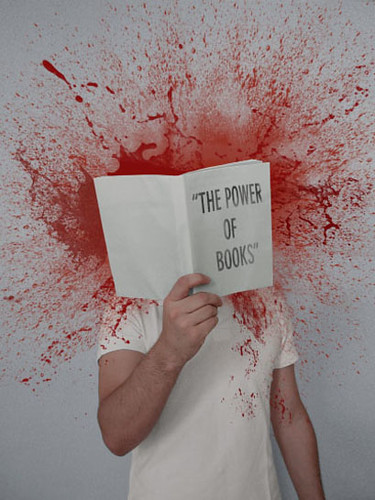
8. They can make your head explode. Really. And this is actually disturbing. There should be studies done.
Good Things About E-books
1. If you own a kindle or an iPad or a nook you are automatically uber-cool and tech savvy. And there is a possibility you will develop super powers.
2. You don't have to worry about becoming a hunchback because a kindle is not very heavy.
3. You can read in the dark. (With Super-vision.) And that's just silly. Silly, but true.
4. You can read as many books at the same time as you want to and never lose your place again.
6. Did I mention that if you own an iPad, nook, or kindle you are awesome?
7. No more danger. Painful and potentially deadly paper cuts are history!
8. Memory capacity almost equal to the Mind of God. Brings literature to the masses. Very alturistic.
Bad Things about E-books
1. If you wanted to take a bath with one, you probably could, but you would die to death if you accidentally dropped it, (metaphorically speaking.) Or, okay, maybe literally also. (electricity + water = bad)
2. If attacked by a mugger, a backpack full of a nook ain'ta gonna do-a you-a mucha good.
3. Frankly, they are just ugly. Little aesthetic appeal.
4. Likely hosts hidden spy software from which the government seeks to implant electrical impulses to control your brain.
5. If you want to high-light or underline something using an actual writing utensil, well, too bad.
6. Can not be used to prop up a wobbly table. And even if you had like a hundred of them, you still could not use them as end tables either.
7. If you buy a kindle, nook, or iPad this month, by next month they will have a newer, better model.