Wednesday, August 25, 2010


Wednesday, August 18, 2010
Books vs. E-Books: 8 reasons to love or hate either.
Good Things About Books:
1. They have sexy spines, esp. when they are all lined up against each other in a library.
2. Marginalia could not exist without them.
3. You can take a bath with one.
4. When feeling uncomfortable in a crowd, you can hold them to your chest. This wards off evil.
5. When you hold a book you hold the entire history of printing and paper in your hands.
6. If you leave random piles around your home, when people visit, they can be used as conversation starters, and also end tables.
7. A backpack full of books makes a good weapon against potential muggers.
8. If you read books, butterflies will fly out of your brain.

Bad Things About Books:
1. If you carry more than fifteen at a time you will develop a hunchback.
2. They get old and turn yellow. Like some people. But that isn't funny. Not at all.
3. They can be damaged by: dogs, little children with teeth, (little children without teeth too) water, fire, and bookworms (though I've never seen one.)
4. You have to kill trees to make books. Someday we may need those trees.
5. Publishers and the politics of publishing. In general and not specifically.
6. Unrequited desire. No matter how many you have, you can never have them all.
7. Sometimes, they smell kinda funny. Like some people. But this isn't very funny either.
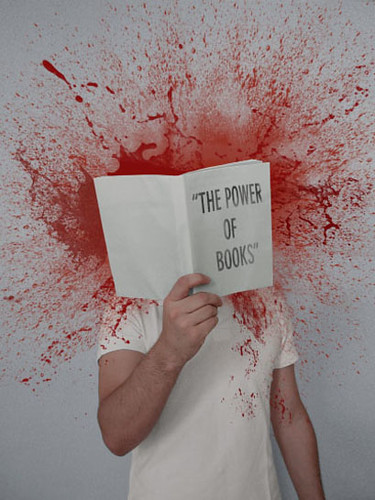
8. They can make your head explode. Really. And this is actually disturbing. There should be studies done.
Good Things About E-books

 | |
| Book of Hours |
Saturday, August 14, 2010
Shiva's Arms Book Review and Author Interview

Tuesday, August 3, 2010

Monday, July 26, 2010
Sewanee Writer's Conference 2010
Dear (Hollins Folks)
First of all, thank you SO MUCH for taking the time to write recommends to Sewanee for me. I’m sure that had a lot to do with my being awarded the Tennessee Williams Scholarship. Secondly, I thought you might like to hear how it went so I wanted to share with you a few things about my experience, which was completely amazing and life altering. I was in a writing workshop directed by Robert Hass and Claudia Emerson. (I am embarrassed to admit that I didn’t even KNOW Robert Hass or anything about his work before I was accepted into the workshop!)
Also in the workshop were some really first-rate poets. A “goose-bump” moment came when my workshop team-mate, Beth Bachman (an emerging poet who won 2008 Donald Hall prize for her first book Temper) gave a reading. She mentioned that the very book she was holding in her hand had its genesis in the workshops she attended when she was a scholar at Sewanee the previous year. I hope this is not annoying, but I do want to share at least one more class member. They were all remarkable poets, but Jehanne Dubrow made quite an impression on me also. She has three books of poetry out and has also won several awards (her latest book is Stateside and it’s amazing.) So, now you kinda get a glimpse of the quality of work I was surrounded with. Needless to say I arrived on campus and felt as if I were, in this company, something between a garden gnome and a gnat.
The craft lectures were probably one of my favorite things to attend. Jill McCorkle and Padget Powell gave talks about writing which about cooked my brain. In a good way, I mean. Powell spent the first ten minutes of his talk going around in circles and explaining why a talk about craft was simply ridiculous. Which, when one is giving a talk about craft one would think one shouldn’t call one’s own talk ridiculous, but who knows? It seemed to work and turned out to be not quite as ridiculous as he had insisted it was even though he began by saying: “My Jesus wears a pink panther suit” and I’m not sure any context will help you out when considering whatever subtext about exposition he might be implying there.
McCorkle likened the act of writing and revision to the internal parts of the body. My favorite comparison was that of the large intestine to “editor.” Also the statement “we will never be as smart as our subconscious,” made me really stop and think, and then after I stopped to think I realized I had to think about stopping to think or maybe it was exactly the opposite…I had to stop thinking about what I was going to be thinking. Or I had to stop thinking. Or something like that.
It was around this time my brain started to obtain the consistency of oatmeal.
Although I think I loved every minute, the first workshop was rough as the first poem I’d selected (The Bookbinding Lesson…I’m not sure if that was one I wrote in any of y’alls workshop or not…) anyway…no one quite got why I juxtaposed bookmaking terminology with average descriptions of a girl walking in the snow. Many in the entire class seemed befuddled and in some cases…annoyed.
So, I wandered back to the dorm after workshop. (Got lost on the way.) Wandered around until I found the way…went to my room…which luckily was easy enough to find. Cried. Felt really good and sorry for myself. Felt closer to gnat size than gnome size for a while. Then, I got myself up and got over it. Moved on. ..
A few really remarkable people I should mention meeting are David Yezzi, (New Criterion) David Barber (Atlanta Monthly) and Don Share (Poetry.) David and David sat on either side of me on the couch during one of the after parties and took turns playing a guitar and singing. In the midst of breaks from the singing (No, I didn’t sing.) we talked. We discussed the ghost of Emily and the future of publishing. Not sure what one subject has to do with the other but somehow it all made sense. (And no, we were none of us sloshed. Or not completely sloshed anyway.)
This is probably going on a bit too long at this point…with (as my children like to say) TMI.
Moving on…okay, I should probably share the most humbling and yet uplifting experiences at the same time *helped me get over the gnat feeling anyway and move beyond gnomish also.* Anyway, the second poem I picked to workshop was called Loom(ing). When Hass gave his craft lecture “The Roots of Being” (which was brilliant) he had the crowd literally singing at the end…anyway, I digress, back to the point…(he somehow managed to show how rhythm and poetry are genetically related. As in…poetry is not IN the genes…it IS the genes…) I don’t know how he did it, but he did…wait, I digress again.
What was I saying? “Rhythm, out of what music does it spring forth?” OH! Yeah, he was talking about this and (a lot more) then he expressed the thought that poems could usually fall into one of two forms: liturgy or lament.
He quoted (from memory) some passages which expounded the idea of rhythm/form as “lament”
(which I did not write down quickly enough so unfortunately I can’t remember.)
THEN! *knock your socks off moment coming, hold on to them…* All right, maybe not so much for you then, for me…I’ll hold on to mine. This still blows me away.
To give an example of a form of liturgy he read my second workshop poem!
I mean, what? I turned to the girl who was sitting next to me whose face and name I no longer remember and I said. “Holy shit. Robert Hass is reading my poem.”
I wasn’t sure what to do with my face. I think it had fallen completely off.
I have to say that again. Pardon me. I hope this doesn’t seem gloating or crass but, Holy Shit. Robert Hass read my poem in a craft lecture.
AND Here’s where I must remark on the excellent teaching at Hollins and how without all of you, well I simply would never had been able to say *third time* Holy shit. Robert Hass read my poem. Aloud. In front of like, people.
(TJ Anderson III, Richard Dillard, Cathryn Hankla, Pauline Kaldas, Thorpe Moeckel and Jeanne Larsen!) How could I forget Jeanne of the Manchu Palaces, Jeanne of the Willow, Wine, Mirror, Moon, Jeanne of the Adv. Studies in Poetry class who had her students create the "Poem without Words"
What’s next? I don’t know. Hass invited me to check out Squaw Valley? I think it is. I know I definitely want to do this writer conference type of thing again!
Speer Morgan, editor of Missouri Review apparently saw me read. He’s invited me to submit a partial manuscript to his magazine.
And…that’s all I can think of.
I’m so glad to be home, but so grateful, humbled, overwhelmed…to have had this experience so I guess I should say this again. THANK YOU. Please give my love to everyone in Swan. Well, give my love but not in a literal way, unless it is a hug, and then you can be literal when you give love from me to everyone.
XXOO
Melanie
PS I DID sing some bluegrass with Claudia and Kent. (Just one song.) I also did a ten second clog routine with her outside the library.
PSS *you are sworn to secrecy on this one.* Jenny Sheridan Pecoraro came to visit me. I took her on a tour of the campus. We went to the library. I got us lost in the basement of the library. I found a long hallway leading to what seemed the only way out of the basement of the library. Neither Jenny nor I noticed the note on the door which read, quite plainly:
Alarm WILL sound if you open the door.
Jenny then gave me this very, very good advice. Which I shall never ever forget.
“If you run, you look guilty.”
Thursday, July 1, 2010
Introducing Chris Noman Part 1

A U B A D E, O C E A N G R O V E
We sat on the beach at high tide
when you finally turned to me, your hands buried
in the sand, asking, like a child, if I saw how far out you went,
the spray
of the Pacific becoming tears upon your worn face.
With a broken shell I drew a white line
down the brown skin of your shoulder,
and said nothing.
Tonight the beach is still. My clothes are scattered on the sand.
Slowly the waves come forward, and the remote lights
of the coast tremble
across the water; red, and deep amber. If once you
could have seen yourself;
the lone figure in my dream
diving so swiftly through the waves
I believed the four seas gathered to ferry only you.
Sometimes, in the dark, I hear you, Brandon,
calling my name, wanting me to follow———
I lie awake
and believe more than anything you are holding me again;
how on nights like this, we’d lie side by side, not moving,
our bodies uncovered in the dark, waiting for a sign;
the taste
of salt on your palm as you covered my mouth,
the last desperate cries gradually silenced by flesh———
Beyond the row of tide markers, the sun rises. Assassins
scale the carved rock at the base of the promontory, and the
waves mount, relentless against the shattered breakers.
You understand, I never wanted either of us
to be saved———
the sky strangely light at this hour, the gulls overhead,
cryless in the wind.

UNBORN CHILD
How quiet you are, how still——
I think you must be waiting.
Sometimes
I believe you were always there
in my body; maybe like the way light
enters our eyes
and hides in us forever———
It’s the closest you’ll ever get
to having a soul: when a child’s dead
inside you.
Last night I dreamed someone
fucked me as I slept.
For all I know, it wasn’t a dream;
I pretended to sleep, maybe I never
opened my eyes———
What death claims it abandons.
Look at me. What do you see in me
that is not surrender? I am
ruined. We both know
I’d give my body up to you again.
![clip_image002[7]](https://blogger.googleusercontent.com/img/b/R29vZ2xl/AVvXsEgA9i5e-26b_9PJ-7Mcu4iXzzmXNB3OiBORz2Mfwl1kcnHkPYjgAoLf0ErKeaVN3tABCic9yNrCfniL6ItzYcr5yQSFtb3AADueYyrmjo9AdVZjH93-JQe5v2Br9RAOxUG8XELLW3SG7tWn/s1600-h/clip_image002%5B7%5D%5B2%5D.jpg "clip_image002[7]")
Thursday, June 10, 2010
Could a Small Independent Publisher Be Right For You?


The personal aspect of working with a small press is what most appealed. I not only wanted, but needed personal attention. Being asked what I thought should be done with Nick’s New Heart was important because this book wasn’t only about my baby (my manuscript), but the book was about my real baby and family. I needed to have some control over how it was presented, the title and the direction.
A small press can offer the uneducated writer publishing knowledge that a large house doesn’t have time to give. The editing process and setting of pages are things easier shared when working with a small publisher. Staying in contact can sometimes be easier because the number of authors isn’t so great. My email and phone calls were always answered in a timely manner. If a writer feels the need to be involved in their book all the way through the publishing press, I would recommend a small press.
 Often independent presses are more open to story ideas and submissions that large press who will pass on them for any number of reasons. The large publishers may think the book idea is good, but that it doesn’t make good business sense. Small press can have less of a slush pile to wade through, meaning a response time is shorter. The author isn’t waiting around for months to hear whether or not the press is interested in their work. Waiting six months to a year to hear back from a large publisher isn’t unusual. In my experience, six weeks to a month is a long time for a small press to hold on to a manuscript.
There are many reputable independent presses that use the same business model as larger publishers but do it on a smaller scale. They offer editors, some give the author a minimum advance, while others don’t but pay higher royalties. Many small presses don’t offer high amounts of promotional money but then at a large publishing house a new author might not get a lot of attention in that area if they aren’t already well known.
If it is important to you that your opinion at least be considered, valued and your voice heard think about submitting to a small publisher. The best thing I ever did for Nick’s New Heart and for me as an author of the book was to sign with a small press. My baby was treated well and so was I. http://www.susancmay.com/index.php
Friday, June 4, 2010
It’s The Bees’ Knees!

What is your vision for Bees' Knees?
My vision for The Bees’ Knees Blog is to create an interactive space where poets can explore language. The blog is divided into three components: Writing, Reading, and the Biz of Poetry.
The Writing:
I post a monthly workshop, poetry prompt, and contest. Poets are encouraged to post their work and give feedback in the comment sections of these monthly posts. The poems submitted at The Bees’ Knees should be in a state of making—in other words, not polished ready for publication poems, but works still in the process of becoming. This is ultimately a place for poetic exploration.
The Reading:
Reading is a large component of The Bees’ Knees Blog. There is a book club that looks at three books over the course of three months: a book on craft, a book by an established author, and a chapbook by an up-and-coming author. There is also a salon where poets can post their favorite poems for an open discussion on why the writing is so good—why it works—how words remake us as we read them.

I also feel very compelled to help promote work that I find fabulous. Poetry is something I want to share. If I read a good book I want to scream from the tops of buildings, this is a very good book and you all should read it. In some aspects the Bees’ Knees is that very tall building, so when I find something good I start yelling about it like a cheerleader drunk on a six-pack of soda-pop.
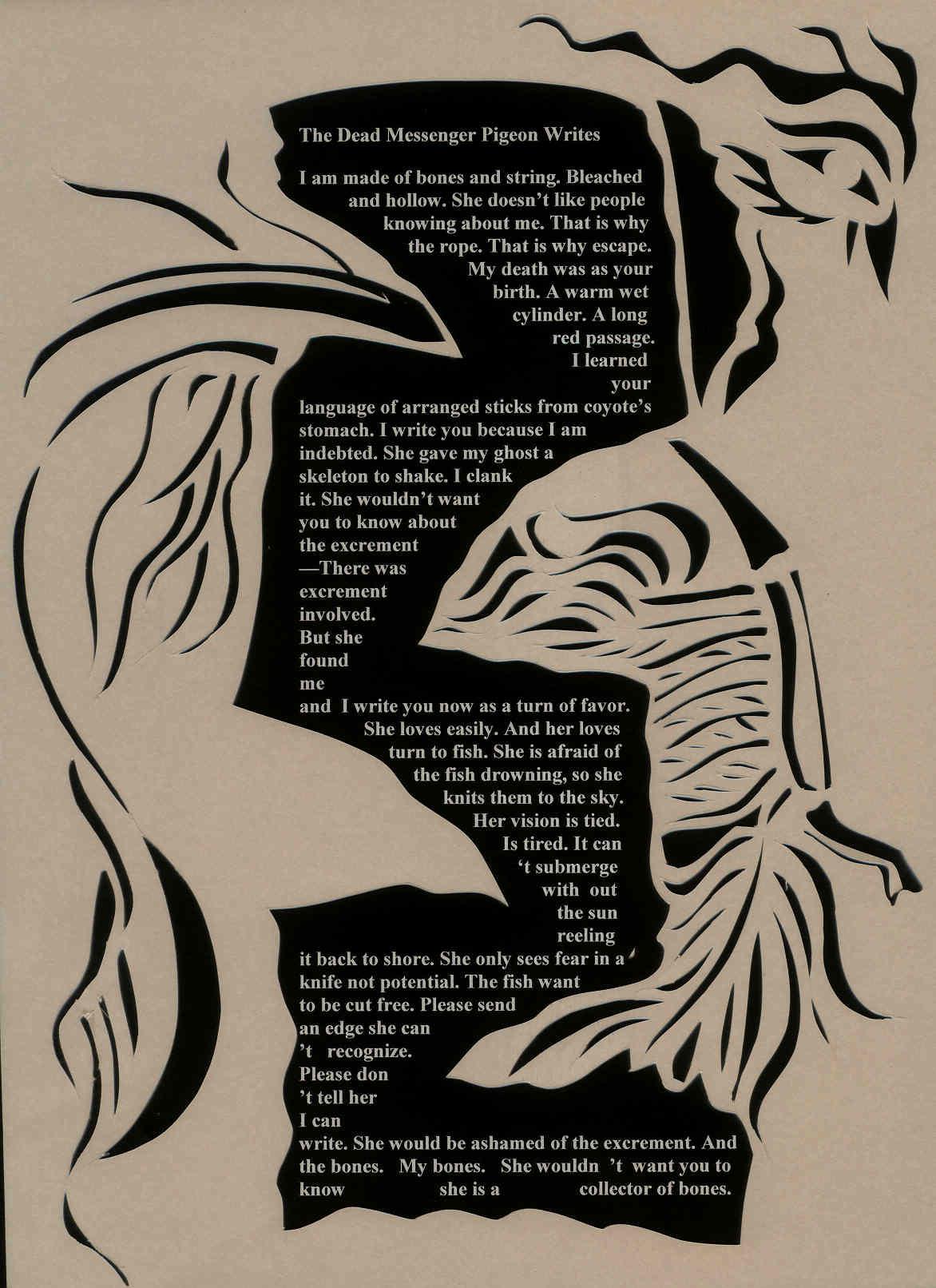
*RUDE NARRATIVE INTRUSION BY THE AUTHOR OF MORTAL CORKSCREW*

AND NOW BACK TO OUR REGULARLY SCHEDULED PROGRAM

The Biz:
In addition to writing and reading I want to provide information about the business of poetry. The word business tastes bad when placed so close to the word poetry—like peanut-butter and pickles—but I haven’t a better word to describe the emotional rollercoaster that is the act of submitting poems.
So here is what I know about peanut-butter and pickles:


Editors are not monsters, they will not kick you, or call you names. They are word lovers to the fullest extent of the word love. An editor is someone who has decided to dedicate their time, money, and heart to provide a place for someone else’s words. I think this information is very important for the poet who is just beginning to submit work to journals. I run a monthly spotlight on editors / journals in order to demystify the process of submitting work. Ultimately, I believe that poetry, like song, is a social animal. It wants friends, cohorts, family, and the company of other poems. The Bees’ Knees wants to be that coffee shop / bar / office / classroom where poets can meet and bond over a cup of great words. A place for community is my hope for the blog. I hope on it and hope on it as though it were my wishing star.
Quote of the Day:
...The poem demands the demise of the poet who writes it and the birth of the poet who reads it.
-Octavio Paz: Alternating Current
Monday, May 31, 2010
For Those Who Carry On
Memorial Day
Remembrance. Today was set aside to think of the fallen. To pay respect to those who have carried guns in defense of ideals, in defense of other people, in defense of their comrades or their own lives. There are many stories being told about courage today. The courage it takes to leave home, to travel across the world into a foreign country and face hatred, to deal with a battle with no clear way out, without knowing when it will end or how long you will be called on, or even if you will be the one who is sent home in a pine box. To choose to live the life of an American soldier shows a strength of character which should be recognized with respect and gratitude. Military service, at the most basic level, is a self-less act. The willingness to sacrifice one's life for others, regardless of the politics or the ideals surrounding the military, is a noble desire.
The military is why we have the security we do. (It’s not the lawyers or politicians, that is for sure.) Men and women have sacrificed their lives for an ideal; the ideal of human equality and the right to exist with dignity and to respect each other without resorting to violence, even when we don’t agree. It is a wonderful thing that we can say whatever we want to say in America and not get punished for disagreeing with those in power. We are a blessed country and a lucky people to live in a place which allows us to express discontent or disagreement without our own military being used against us. Certainly, it goes without saying that it is not a perfect institution and mistakes have been made by individuals in the past and mistakes will be made in the future, no man and no man made institution is perfect. But at the heart of the majority of individuals serving in the armed forces is a person who believes in service, a person who believes one individual can make a difference, a person willing to die for others.
But there are some heroes who do not carry a gun, they simply carry on. There is of a different kind of war going on today and it is a war within the households across the world. Today, while I honor the fallen I would also like to honor the living. Please note, the images following will be disturbing to some.
WORLD IN A SNAP | Interesting images from around the world
Terrorism that's personal (12 images)
EDITOR'S NOTE: GRAPHIC CONTENT
Text by Jim Verhulst, Times' Perspective editor | Photos by Emilio Morenatti, Associated Press
We typically think of terrorism as a political act.
But sometimes it’s very personal. It wasn’t a government or a guerrilla insurgency that threw acid on this woman’s face in Pakistan. It was a young man whom she had rejected for marriage. As the United States ponders what to do in Afghanistan — and for that matter, in Pakistan — it is wise to understand both the political and the personal, that the very ignorance and illiteracy and misogyny that create the climate for these acid attacks can and does bleed over into the political realm. Nicholas Kristof, the New York Times op-ed columnist who traveled to Pakistan last year to write about acid attacks, put it this way in an essay at the time: “I’ve been investigating such acid attacks, which are commonly used to terrorize and subjugate women and girls in a swath of Asia from Afghanistan through Cambodia (men are almost never attacked with acid). Because women usually don’t matter in this part of the world, their attackers are rarely prosecuted and acid sales are usually not controlled. It’s a kind of terrorism that becomes accepted as part of the background noise in the region. ...
“Bangladesh has imposed controls on acid sales to curb such attacks, but otherwise it is fairly easy in Asia to walk into a shop and buy sulfuric or hydrochloric acid suitable for destroying a human face. Acid attacks and wife burnings are common in parts of Asia because the victims are the most voiceless in these societies: They are poor and female. The first step is simply for the world to take note, to give voice to these women.” Since 1994, a Pakistani activist who founded the Progressive Women’s Association to help such women “has documented 7,800 cases of women who were deliberately burned, scalded or subjected to acid attacks, just in the Islamabad area. In only 2 percent of those cases was anyone convicted.”
The geopolitical question is already hard enough: Should the United States commit more troops to Afghanistan and for what specific purpose? As American policymakers mull the options, here is a frame of reference that puts the tough choices in even starker relief: Are acid attacks a sign of just how little the United States can do to solve intractable problems there — therefore, we should pull out? Or having declared war on terrorism, must the United States stay out of moral duty, to try to protect women such as these — and the schoolgirls whom the Taliban in Afghanistan sprayed with acid simply for going to class — who have suffered a very personal terrorist attack? We offer links to smart essays that come to differing conclusions.
• In August, Perspective published a New York Times Magazine piece that followed up the story of Afghan sisters Shamsia and Atifa Husseini, who were attacked with acid simply for attending school. If you wish to refresh your memory, you may read the original article.
• Two very smart, informed observers come to opposite conclusions on the proper U.S. course of action in Afghanistan:
1. In his “Think Tank” blog at NewYorker.com, Steve Coll argues why we can’t leave — “What If We Fail In Afghanistan?” Read the essay in full.
2. In an essay entitled “The War We Can’t Win” in Commonweal (also reprinted in the November issue of Harper’s), Andrew J. Bacevich makes the case that we are overstating the importance of Afghanistan to U.S. interests. Bacevich is a professor of International Relations at Boston University and the author, most recently, of The Limits of Power. A retired Army lieutenant colonel, he served from 1969 to 1992, in Vietnam and the first Persian Gulf War. He was a conservative critic of the Iraq war. Several of his essays have run before in Perspective. Read his essay in full.
• Read the original story about acid attacks by Nicholas Kristof.

Irum Saeed, 30, poses for a photograph at her office at the Urdu University of Islamabad, Pakistan, Thursday, July 24, 2008. Irum was burned on her face, back and shoulders twelve years ago when a boy whom she rejected for marriage threw acid on her in the middle of the street. She has undergone plastic surgery 25 times to try to recover from her scars.

Shameem Akhter, 18, poses for a photograph at her home in Jhang, Pakistan, Wednesday, July 10, 2008. Shameem was raped by three boys who then threw acid on her three years ago. Shameem has undergone plastic surgery 10 times to try to recover from her scars.

Najaf Sultana, 16, poses for a photograph at her home in Lahore, Pakistan on Wednesday, July 9, 2008. At the age of five Najaf was burned by her father while she was sleeping, apparently because he didn't want to have another girl in the family. As a result of the burning Najaf became blind and after being abandoned by both her parents she now lives with relatives. She has undergone plastic surgery around 15 times to try to recover from her scars.

Shehnaz Usman, 36, poses for a photograph in Lahore, Pakistan, Sunday, Oct. 26, 2008. Shehnaz was burned with acid by a relative due to a familial dispute five years ago. Shehnaz has undergone plastic surgery 10 times to try to recover from her scars.

Shahnaz Bibi, 35, poses for a photograph in Lahore, Pakistan, Sunday, Oct. 26, 2008. Ten years ago Shahnaz was burned with acid by a relative due to a familial dispute. She has never undergone plastic surgery.

Kanwal Kayum, 26, adjusts her veil as she poses for a photograph in Lahore, Pakistan, Sunday, Oct. 26, 2008. Kanwal was burned with acid one year ago by a boy whom she rejected for marriage. She has never undergone plastic surgery.

Munira Asef, 23, poses for a photograph in Lahore, Pakistan, Sunday, Oct. 26, 2008. Munira was burned with acid five years ago by a boy whom she rejected for marriage. She has undergone plastic surgery 7 times to try to recover from her scars.

Bushra Shari, 39, adjusts her veil as she poses for a photograph in Lahore, Pakistan, Friday, July. 11, 2008. Bushra was burned with acid thrown by her husband five years ago because she was trying to divorce him. She has undergone plastic surgery 25 times to try to recover from her scars.

Memuna Khan, 21, poses for a photograph in Karachi, Pakistan, Friday, Dec. 19, 2008. Menuna was burned by a group of boys who threw acid on her to settle a dispute between their family and Menuna's. She has undergone plastic surgery 21 times to try to recover from her scars.

Zainab Bibi, 17, adjusts her veil as she poses for a photograph in Islamabad, Pakistan, Wednesday, Dec. 24, 2008. Zainab was burned on her face with acid thrown by a boy whom she rejected for marriage five years ago. She has undergone plastic surgery several times to try to recover from her scars.

Naila Farhat, 19, poses for a photograph in Islamabad, Pakistan, Wednesday, Dec. 24, 2008. Naila was burned on her face with acid thrown by a boy whom she rejected for marriage five years ago. She has undergone plastic surgery several times to try to recover from her scars.

Saira Liaqat, 26, poses for the camera as she holds a portrait of herself before being burned, at her home in Lahore, Pakistan, Wednesday, July 9, 2008. When she was fifteen, Saira was married to a relative who would later attack her with acid after insistently demanding her to live with him, although the families had agreed she wouldn't join him until she finished school. Saira has undergone plastic surgery 9 times to try to recover from her scars.
